AI Agent Failures Are System Design Failures, Not Model Failures
When an enterprise AI agent acts unpredictably, teams instinctively blame the underlying foundation model. In reality, most agent breakdowns are architectural breakdowns: vague goals, unconstrained permissions, missing approval gates, and absent rollback paths.
The Illusion of Model Failure
Across enterprise pilot projects, engineering teams assign an AI agent an ambitious, open-ended directive: “resolve the incident,” “update the customer records,” or “optimize cloud infrastructure spend.” Weeks later, when the agent takes destructive actions, gets stuck in reasoning loops, or generates unexpected mutations, the project is halted and the model gets blamed for lacking sufficient reasoning intelligence.
Yet in post-incident audits, the failure almost never traces back to the raw token prediction capability of the model. Instead, it traces back to an absence of standard systems engineering. Teams give agents wide latitude without the basic control loops, bounds, and guarantees they would demand from any junior or mid-level engineer.
The Core Axiom
“In practice, a moderately capable model inside a disciplined workflow is far more dependable than a powerful frontier model operating without boundaries.”
5 Common Systems Design Flaws
Before evaluating another foundational LLM or re-prompting an agent, engineering leaders should inspect the five systemic gaps that precipitate most production incidents:
1Vague Success Criteria
Giving an agent an abstract target without verifiable acceptance tests. If an automated script cannot evaluate whether a state change succeeded or failed through an exit code or health check, an LLM cannot guess the criteria either.
2Excessive, Unscoped Permissions
Equipping an agent with raw admin API tokens, unrestricted SQL write access, or broad terminal execution rights. Violating the Principle of Least Privilege turns slight hallucination or misinterpretation into an outage.
3No Approval Checkpoints for High-Impact Actions
Treating autonomy as an all-or-nothing binary. Systems that allow autonomous deletes, firewall updates, or external communications without human validation introduce catastrophic tail risks into production.
4No Reliable Rollback Mechanism
Executing state mutations without atomic transaction boundaries or pre-tested compensating actions. When an agent touches third-party APIs or infrastructure, reversing the partial execution is rarely addressed.
5No Rule for Escalating Uncertainty
Forcing an agent to complete a task regardless of confidence scores or ambiguous tool responses. Without an explicit fallback circuit breaker, agents will invent plausible reasoning paths instead of halting and asking for assistance.
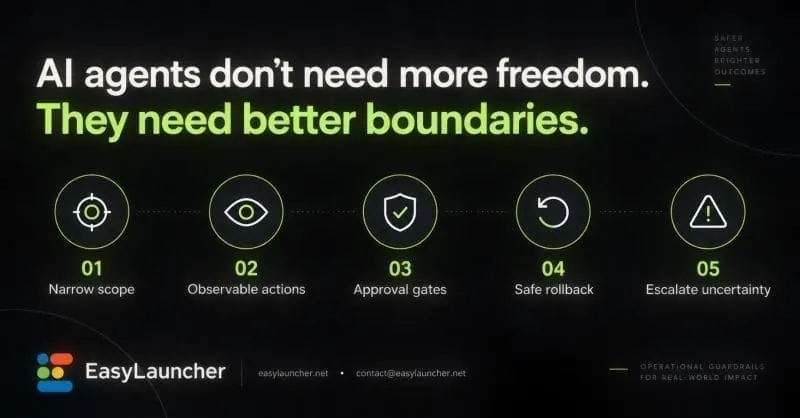
5 Non-Negotiable Operational Guardrails
A reliable production AI agent requires the exact same operational hygiene as a senior engineer on call. When designing agentic platforms, implement these five structural pillars:
- 1. Narrowly Defined Responsibility: Design agents as specialized micro-services with deterministic tool interfaces rather than generalist thinkers. Constrain their scope to explicit state transformations with schemas validated by runtime checkers (e.g. Zod or JSON Schema).
- 2. Complete Visibility Into Every Action: Stream structured telemetry using OpenTelemetry for every prompt, tool payload, token count, latency measurement, and environment mutation. Auditing must answer who, what, when, and why for every agent step.
- 3. Human Approval for High-Impact Decisions: Implement graduated permission gates. Read operations and deterministic staging queries can execute autonomously; mutating production data, scaling cloud tiers, or sending external communications must trigger an interactive review webhook.
- 4. A Safe and Tested Rollback Mechanism: Every mutating tool must pair with an idempotent compensating action (the Saga pattern for agents). If a post-condition fails, the orchestrator triggers automated compensation rather than relying on the LLM to invent an undo script.
- 5. Clear Conditions for Stopping and Asking for Help: Define concrete circuit breakers: maximum tool retries, token spend ceilings, low-confidence thresholds, and ambiguous input triggers that immediately hand control back to human engineers.
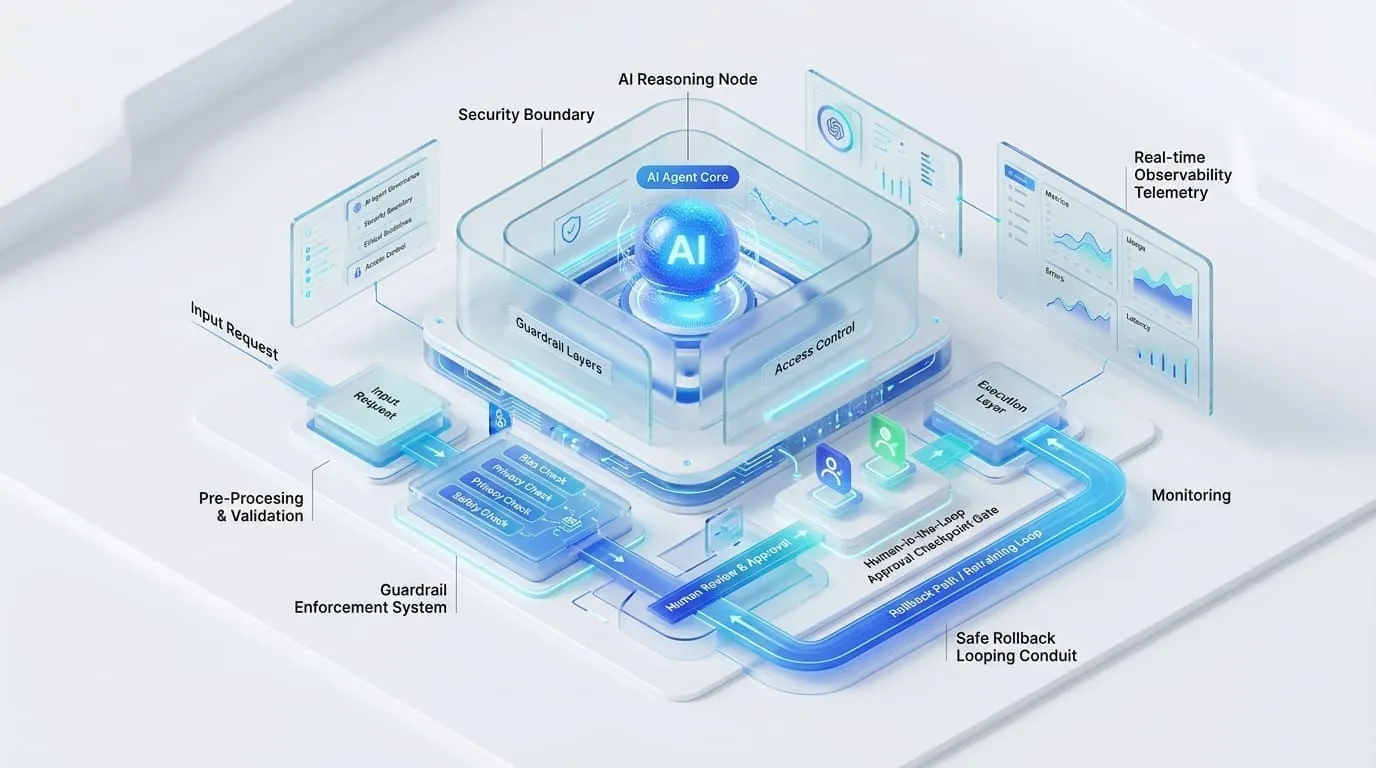
Architectural Blueprint: The 5 Non-Negotiable Operational Guardrails for Production Autonomous AI Systems.
Prompt Engineering vs. Operational Contracts
System prompts should describe task context, but operational contracts enforce safety. Relying on phrases like “please be careful not to delete tables” inside a system prompt is not security: it is wishful thinking. True enforcement happens outside the model, within deterministic orchestration middleware.
Unbounded Agents vs. Contract-Driven Agents
| Dimension | Unbounded Agent (Fragile) | Contract-Driven Agent (Production) |
|---|---|---|
| Scope | Broad, open-ended business objectives | Narrowly bounded, verifiable operational tasks |
| Tool Access | Direct database, terminal, or admin tokens | Scoped, schema-validated micro-APIs with least privilege |
| Governance | Prompt guidelines (“Do not make mistakes”) | Deterministic runtime middleware and policy gates |
| High-Impact Actions | Executed autonomously without warning | Graduated HITL (Human-in-the-Loop) approvals |
| Failure Recovery | Hallucinated error retry loops | Idempotent compensating rollbacks (Saga pattern) |
| Uncertainty Handling | Hallucinates answers to fulfill user request | Halts execution, records state, and alerts human operators |
Evaluating the System Before the Model
Autonomy does not mean removing humans from the process. It means defining precisely when a system may act independently, when it must request approval, and how it safely recovers when something goes wrong.
Before migrating to the newest frontier model or adjusting hyper-parameters, audit your agent runtime. Building robust guardrails, deterministic validators, and explicit operational contracts is how enterprise engineering organizations transition AI agents from unreliable demos into dependable production infrastructure.
Deploying Enterprise AI Agents in Production?
EasyLauncher partners with engineering teams to design contract-driven agentic architectures, automated verification pipelines, and self-healing cloud infrastructure with 100% client IP ownership.
Related Insights & Solutions
Continue exploring how we engineer resilient, high-performance technology.