AI-Driven Observability & AIOps: Autonomous Incident Remediation
Modern distributed microservices generate petabytes of telemetry daily. SRE teams can no longer diagnose cascading failures manually. AIOps harnesses machine learning to predict outages and automate incident resolution in real-time.

The Death of Static Alert Thresholds
Traditional monitoring relies on rigid threshold alerts such as “CPU > 85%” or “error rate > 1%”. In dynamic multi-cloud environments, these static rules inevitably cause severe alert fatigue or miss subtle, slow-degradation anomalies across distributed dependency graphs.
AIOps leverages real-time statistical modeling and deep learning across unified OpenTelemetry signals (metrics, logs, distributed traces, and continuous profiling) to recognize multidimensional anomalous patterns long before they escalate into user-facing outages.
Key Architectural Capabilities in 2026
- Real-time Event Correlation: Grouping thousands of noisy alerts from microservice tiers into a single contextual incident timeline, cutting noise by over 80%.
- Dynamic Dependency Mapping: Continuous topology discovery that traces request flows across Kubernetes clusters, edge nodes, and third-party APIs.
- Automated Root Cause Identification: Pinpointing the exact anomalous commit, bad configuration push, or upstream database bottleneck within seconds of detection.
- Autonomous Self-Healing Runbooks: Executing verified remediation playbooks such as progressive traffic drain, automatic rollback, connection pool tuning, or pod restarts.
The SRE Human-in-the-Loop Paradigm
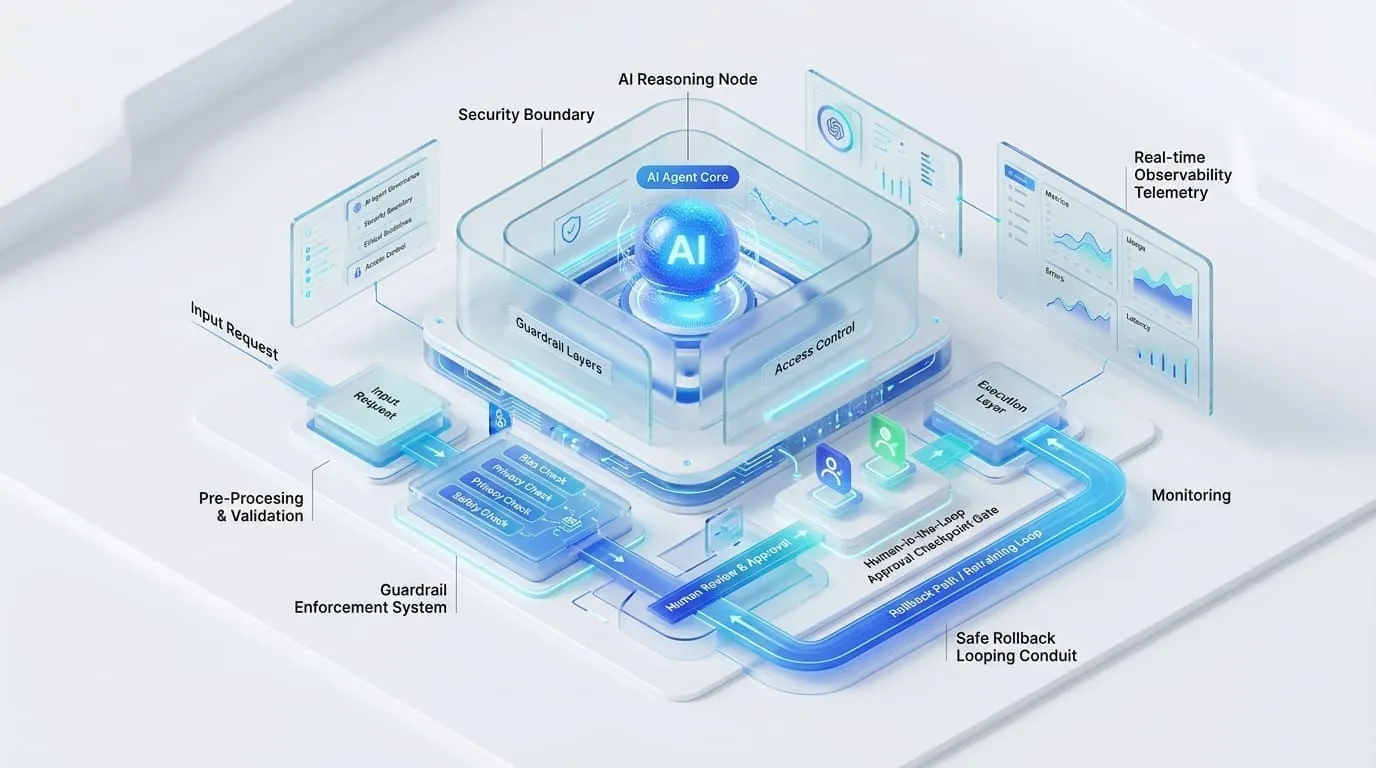
Autonomous operations do not mean blind execution. Advanced enterprise AIOps systems employ graduated confidence scoring:
- High Confidence (>95%): Autonomous self-healing execution with instant SRE audit logging
- Medium Confidence (80-95%): 1-click suggested remediation actions in Slack / Teams incident channels
- Exploratory: Detailed contextual hypothesis generation presented to on-call engineers
Building for High Availability
Implementing AI-driven observability transforms site reliability engineering from reactive fire-fighting into a proactive discipline. By slashing Mean Time to Detection (MTTD) and Mean Time to Resolution (MTTR), engineering organizations achieve five-nines availability while maintaining high deployment velocity.
Related Insights & Solutions
Continue exploring how we engineer resilient, high-performance technology.