A Backup Is Only a Promise, A Restore Test Is Proof
A green backup dashboard does not mean your systems are recoverable. It only proves bits were written to storage. True disaster recovery requires testing the complete restoration path under realistic incident conditions: isolate, restore, verify, and measure.
The Illusion of Green Backup Dashboards
Every week, engineering leaders and DevOps teams log into their cloud dashboards and feel reassured by a long column of bright green checkmarks. AWS Backup, Azure Site Recovery, Veeam, or custom cron-driven pg_dump scripts report 100% completion. The alerts are silent. The audit reports look clean.
Yet when ransomware encrypts the primary volume, an errant deployment executes an unrecoverable database migration, or an entire availability zone suffers catastrophic physical degradation, that reassuring green dashboard frequently turns out to be an optical illusion.
The Operational Reality
“A backup job completing successfully proves only that data was written somewhere. It does not prove that the data can be recovered, decrypted, reassembled, or run in production.”
In real incidents, failure strikes not during the write step, but during the reconstructive assembly. Backups often fail silently due to subtle, undiscovered discrepancies:
- Silent Bitrot & Truncation: The dump file wrote successfully to S3, but network timeouts truncated the tail end of the transaction logs, corrupting relational integrity.
- Rotated KMS Keys: The snapshot was encrypted with a KMS customer-managed key whose policy was modified or rotated six months later, rendering the snapshot unreadable by the recovery IAM role.
- Configuration Drift: The database dumps cleanly, but the application container definitions, environment variables, SSL certificates, and secrets stored in external vaults were never backed up alongside the persistence layer.
- Orphaned Schema Dependencies: Cross-database foreign keys or third-party schema extensions (e.g. pgvector, PostGIS) were updated in production without corresponding install steps documented in the bare-metal restore scripts.
The 4 Hard Questions of True Recovery
Moving beyond passive backup monitoring requires answering four uncompromising architectural questions. These four stages transform disaster recovery from an unvalidated hypothesis into verifiable operational muscle memory:
Isolate
Non-Destructive Staging
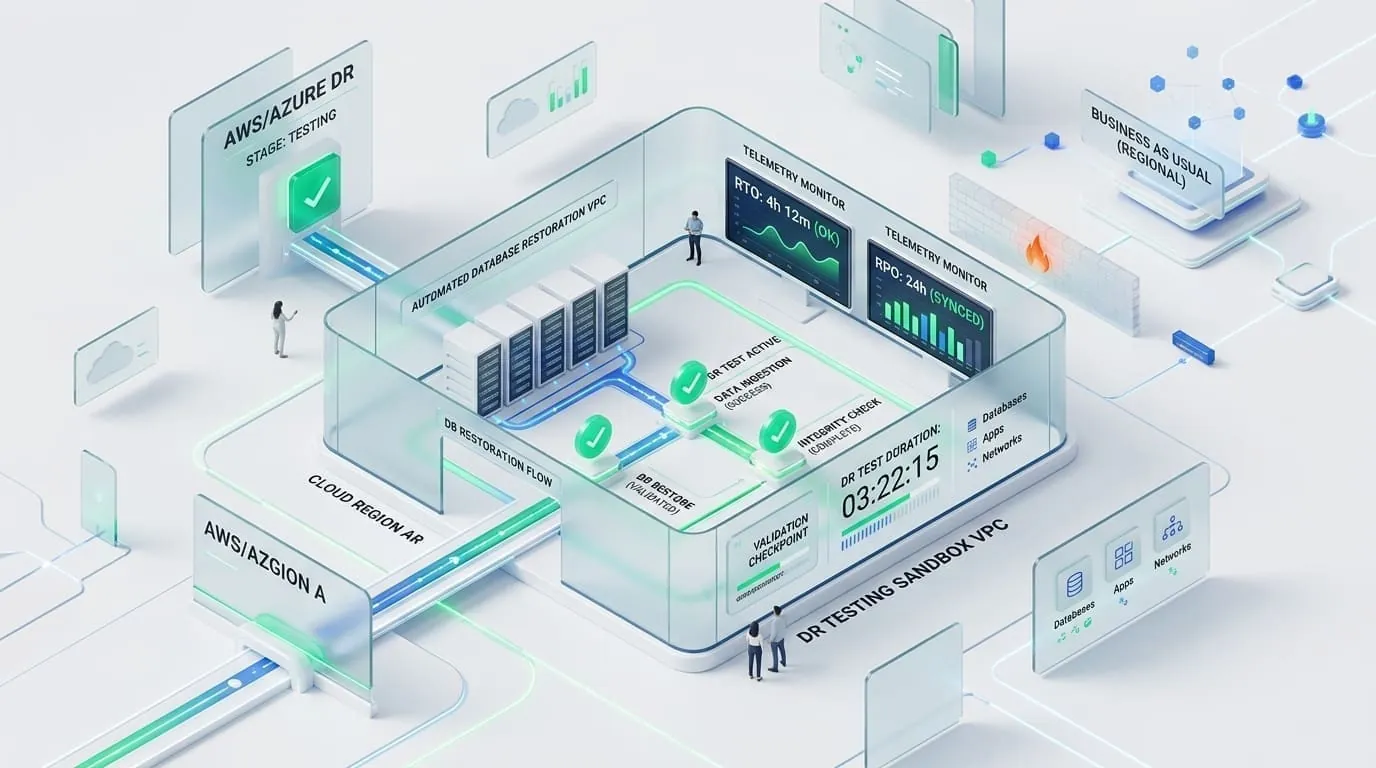
Can recovery be initiated without risking production state? If testing a restore requires taking systems offline or risking write collisions with live customer traffic, drills will never happen. Testing must occur inside isolated, ephemeral sandbox VPCs with synthetic network boundaries.
Restore
Comprehensive Reconstruction
Can the correct data, exact infrastructure configs, network routes, DNS records, and service dependencies be reconstructed from cold storage? A database without its surrounding ingress rules, microservices, and secrets vault is dead silicon.
Verify
End-to-End Application Integrity
Does the application actually boot, authenticate users, process synthetic credit cards, and serve HTTP 200 OK responses against the restored dataset? Restored rows that cannot pass application-level validation or schema integrity constraints are worthless.
Measure
Empirical RTO & RPO Telemetry
How many wall-clock minutes did the complete restoration take, and exactly how many seconds of transactions were lost? Theoretical Recovery Time Objectives (RTO) in compliance slide decks mean nothing if actual AWS disk volume hydration takes 14 hours.
Recovery Path Architecture Blueprint
The infographic below outlines the cyclical four-phase discipline required for battle-tested enterprise disaster recovery:
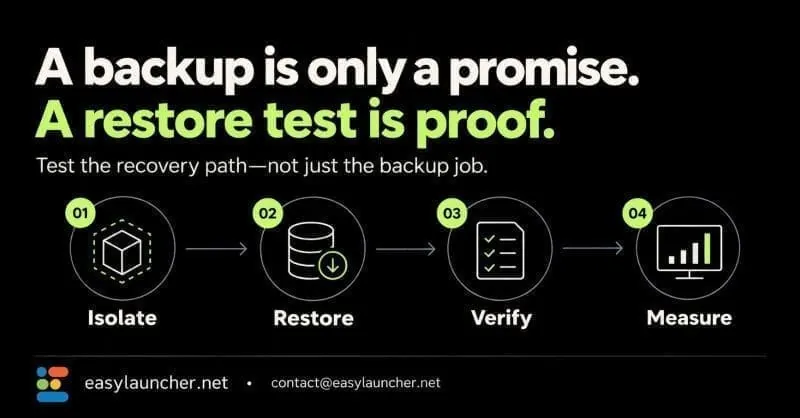
Architectural Standard: Test the complete recovery path, not just the backup job.
Anatomy of an Unforgiving Recovery Drill
Running a legitimate disaster recovery drill requires deliberately stripping away artificial conveniences. In a real emergency, the primary lead architect might be on a transcontinental flight, the VPN may be degraded, and production access tokens might be locked out.
When EasyLauncher conducts disaster recovery audits and automated pipeline setups, we mandate running drills under realistic conditions:
Eliminate the “Hero Engineer” Dependency
If successful recovery depends on one specific engineer being awake, reachable, and holding undocumented credentials in their local terminal history, your recovery strategy has already failed. Hand the runbook to a junior engineer who has never touched the subsystem, give them standard permissions, and observe where the instructions stall.
Audit Credential & KMS Decoupling
Does the disaster recovery target environment rely on the primary environment’s HashiCorp Vault or AWS IAM roles to decrypt data? If an AWS account compromise or IAM role revocation triggers the disaster, your target recovery VPC will be locked out of the very backups it needs to boot. Ensure air-gapped, cross-account replication with isolated encryption keys.
Automate Ephemeral Sandbox Provisioning
Modern platform engineering uses declarative Infrastructure-as-Code (Terraform or OpenTofu) to spin up clean, throwaway VPCs on demand. Automated CI/CD cron triggers pull the latest database snapshot, hydrate volumes, run automated end-to-end Playwright and API regression suites, log verified RTO timing metrics, and tear down the infrastructure immediately to keep costs minimal.
Backup-Centric vs. Recovery-Validated Resilience
Examine how an organization’s architectural mindset shifts when transitioning from check-the-box compliance to engineering-grade business continuity:
| Operational Dimension | Backup-Centric Mindset (Fragile) | Recovery-Validated SRE (Resilient) |
|---|---|---|
| Success Criteria | Cron job returned exit code 0; file exists on S3 | Application booted, served real API traffic, and passed DB consistency checks |
| Infrastructure Strategy | Assumes target servers and networks already exist | Declarative IaC spins up isolated target VPCs, subnets, and routing from scratch |
| RTO & RPO Tracking | Theoretical numbers documented in an unread PDF | Empirically measured and graphed in Datadog/Grafana every drill |
| Testing Cadence | Annual paper audit or manual scramble before compliance reviews | Weekly automated restore drills in ephemeral sandboxes plus unannounced team drills |
| Secret & KMS Governance | Single shared root account credentials in password manager | Air-gapped cross-region KMS keys and automated secret rotation |
| Team Execution | Depends on the memory and terminal history of one veteran engineer | Version-controlled, automated pipelines executable by any engineer on call |
The SRE Metric That Actually Matters
Auditors and board members frequently ask: “Are our backups running successfully?”
The modern SRE answer must challenge that premise:
Fragile Telemetry
“Last backup: successful.”
Production Resilience
“Last recovery drill: successful; completed in 42 minutes with zero data divergence.”
When did your team last test the complete recovery path rather than just verifying the backup job? If the answer is longer than 30 days ago, or if testing requires taking down customer-facing systems, your business continuity plan is an untested theory.
Need Battle-Tested Disaster Recovery Architecture?
EasyLauncher works directly with enterprise engineering teams to design automated restore drills, live zero-downtime database migrations, and isolated multi-region recovery environments.
Related Insights & Solutions
Continue exploring how we engineer resilient, high-performance technology.