Automating Chaos Only Makes Chaos Faster: Why Automation Projects Fail
Most failed automation projects are not technology problems. They are process problems given an API. When organizations digitize broken, ambiguous workflows without redesign, they do not eliminate friction. They merely accelerate confusion.
Process Problems Given an API
Every year, enterprises invest millions in digital transformation, low-code workflow platforms, custom SaaS portals, and AI agents. Yet months after deployment, leadership teams often find themselves confronting familiar dysfunctions:
- Customer records remain duplicated across multiple departments.
- Critical approval ownership remains murky and disputed.
- Edge cases and exceptions still happen outside the software via private email chains and chat pings.
- Financial and operational dashboards continue to display conflicting versions of the truth.
The instinctive reaction is to blame the software, switch vendors, or swap the underlying framework. But in the vast majority of cases, the technology functioned exactly as specified.
“Automating chaos does not eliminate chaos. It only makes chaos faster.”
EasyLauncher Systems Architecture PracticeWhen an unorganized, fractured business process is connected to APIs, webhooks, or autonomous agents, the speed of error generation scales linearly with your compute power. Before writing a line of code or prompting an AI model, engineering teams must step back and redesign the operating model itself.
The 5 Questions Before Writing Code or Introducing AI
Before investing in software engineering or deploying autonomous agents, product owners and business architects must reach unequivocal clarity on five foundational questions.
1. What Event Starts the Workflow?
Vague triggers produce unreliable systems. Saying “a customer requests an onboarding quote” is an operational description, not a technical trigger.
Does the workflow begin when a web form is submitted, when an identity verification webhook returns a verified status, or when an account executive flags a CRM deal stage? Defining the canonical event payload, its timestamp, and idempotency guarantees ensures that workflows cannot be triggered multiple times or executed on partial data.
2. Who Owns Each Decision?
Automated systems stall when permission boundaries are ambiguous. When an invoice requires a non-standard discount or an edge-case contract term is requested, who possesses the formal authority to sign off?
If approval logic relies on collective consensus or informal chat threads, software cannot model the path. Every branching condition in your business logic requires a single, named organizational role with explicit escalation thresholds and timeout rules.
3. Which Exceptions Happen Regularly?
In traditional legacy workflows, people handle exceptions through ad-hoc offline maneuvers: editing a spreadsheet manually, bypassing a billing check, or texting an engineer for a manual database patch.
When automating, regular variances must be treated as first-class citizens in the system design. If 15% of supplier deliveries arrive with partial shipments, that is not an unexpected anomaly: it is a recurring business state that demands its own deterministic validation and reconciliation branch.
4. Where Should the Authoritative Record Live?
Split-brain state is the death of reliable software. When customer contact details live in Salesforce, billing addresses in QuickBooks, and order histories in Postgres, which repository is authoritative when conflicts arise?
A resilient architecture designates a strict System of Record (SoR) for each business entity. All other microservices, dashboards, and AI agents must treat that SoR as the immutable source of truth, synchronizing state via verified event queues rather than direct, conflicting writes.
5. What Business Outcome Will Prove the Solution Works?
Digitizing for the sake of digitization creates software that employees actively work around. The success of an automated platform must be tied to unambiguous, verifiable metrics:
- Reducing order-to-delivery lead time from 72 hours to 4 hours.
- Slashing manual invoice reconciliation errors by 95%.
- Eliminating after-hours escalation tickets for tier-1 customer onboarding.
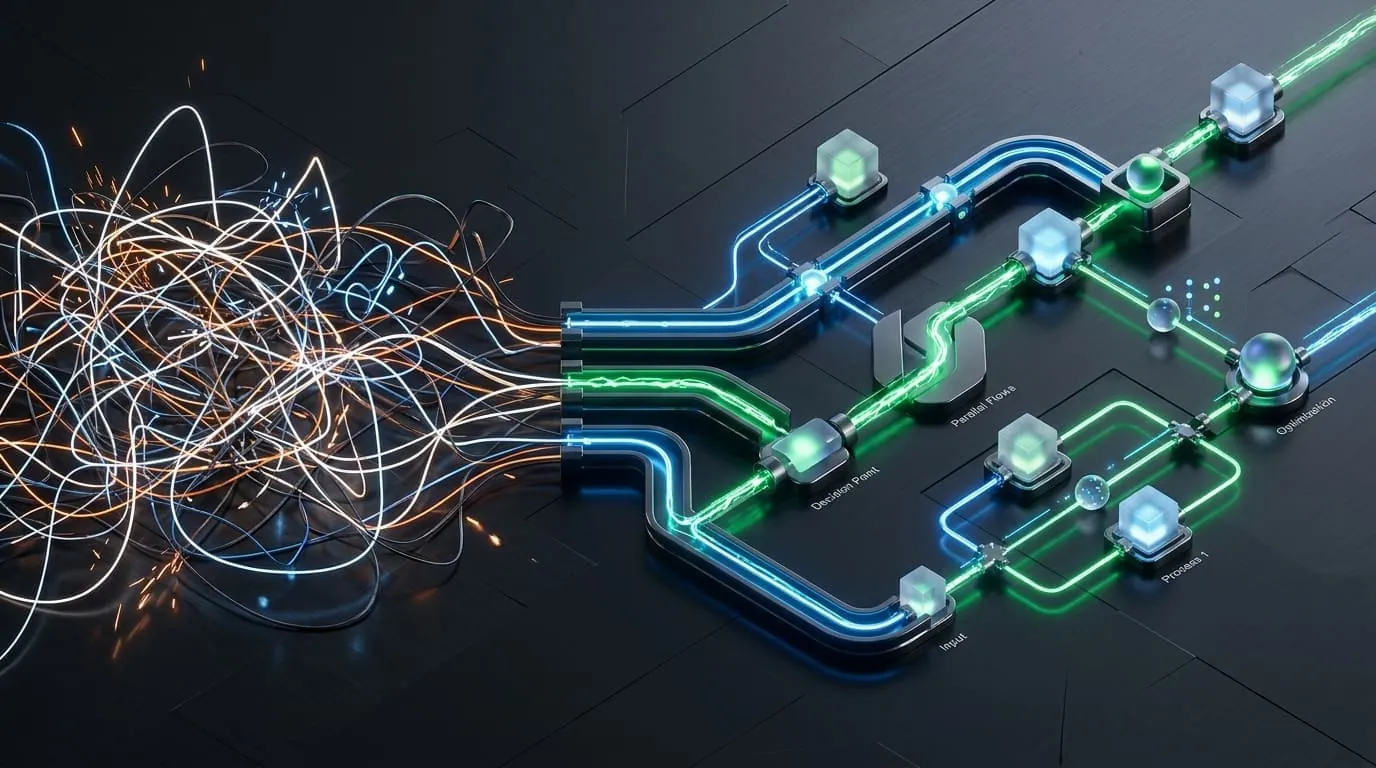
Messy Process vs. Designed System: The Architectural Contrast
The difference between fragile automation and resilient enterprise infrastructure is evident in the topology of the system:
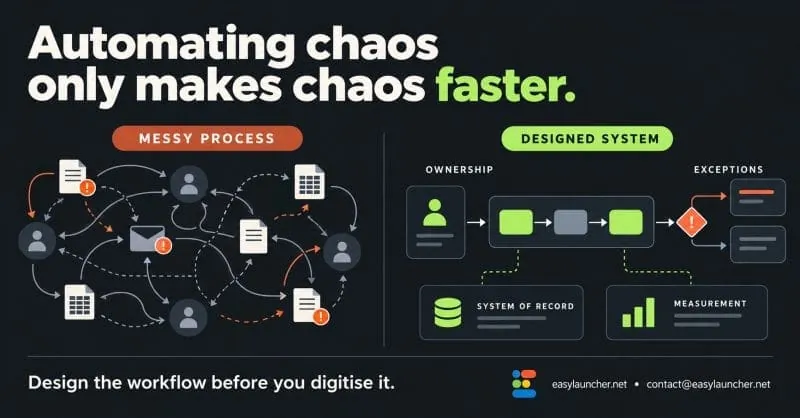
Figure 1: Messy Process vs. Designed System: Design the workflow before you digitise it.
| Dimension | Messy Process (Digitized Chaos) | Designed System (Governed Architecture) |
|---|---|---|
| Execution Flow | Tangled, circular handoffs across email, forms, and chat | Linear, unidirectional pipeline with explicit state machine transitions |
| Authority & Ownership | Dispersed across committees; unclear who signs off | Deterministic role assignment with automated escalation SLAs |
| State Management | Multiple conflicting spreadsheets and localized databases | Single authoritative System of Record (SoR) with verified sync |
| Exception Paths | Handled outside the software through private messages | Engineered exception branches with audit trails and human review |
| Telemetry | Zero visibility into process bottlenecks or cycle stalls | Real-time observability tracking latency, drop-off, and throughput |
Deterministic Rules vs. AI Workflows: Selecting the Right Engine
A common pitfall in modern digital transformation is forcing AI into problems that require deterministic precision, or using brittle hard-coded rules for unstructured ambiguities.
High-performing enterprise solutions recognize that the most effective architecture is almost always a thoughtful combination:
Deterministic Automation
Best for structured, predictable paths where logic is binary and non-negotiable: database updates, financial ledger postings, schema validation, and webhook dispatching.
Strength: 100% repeatability & sub-millisecond latencyAI & Agentic Workflows
Best for unstructured inputs, multi-lingual communications, cognitive classification, and fuzzy data normalization across legacy documents and incoming support inquiries.
Strength: Semantic comprehension & flexible extractionIn a well-designed system, deterministic software executes the predictable baseline pipeline, while AI classifies ambiguous inputs, and designated human operators review consequential or high-risk edge cases.
Anatomy of an Operating Model: The Lead-to-Quote Paradigm
Consider a B2B enterprise seeking to automate its lead-to-quote process.
A naive digitization effort simply builds a web form that copies input fields into Salesforce and emails a sales manager. When discounts exceed normal margins, reps negotiate exceptions over Slack, quotes are generated in local Excel files, and finance only discovers margin leakage weeks later during billing.
A properly designed system re-engineers the operating model:
- Pricing Authority Enforced at the Edge: Discount thresholds are programmed into the product configuration engine. Quotes within bounds are approved automatically; quotes exceeding bounds route directly to the designated VP with time-stamped escalation.
- Unified Customer Master: Tax IDs and corporate entities are reconciled in real time against the ERP master registry, preventing split accounts and duplicate records.
- Automated Bottleneck Telemetry: Every deal phase records stage duration. Leadership dashboards expose exactly where quotes linger, distinguishing between sales latency, credit checks, and legal reviews.
The Executive Takeaway: Design Before Digitisation
The purpose of custom software and business automation is not merely to digitize existing manual habits. It is to replace fragmented, unmonitored handoffs with an operational architecture that stakeholders can understand, measure, and trust.
Before investing in custom code, workflow engines, or enterprise AI, identify the core process that needs redesign. Technology can accelerate your operations; only thoughtful architecture can improve them.
Architecting High-Trust Enterprise Workflows
At EasyLauncher, our senior engineers and systems architects partner with business leaders to design, build, and deploy production-grade automation systems: from algorithmic financial reconciliation to multi-site warehouse operations.
Related Insights & Solutions
Continue exploring how we engineer resilient, high-performance technology.