Your Customer Portal Should Not Become Your Newest Source of Truth
Imagine a customer updates their address in a portal. The CRM retains the old address. The ERP generates an invoice using another version. The support dashboard shows something different again. No individual application is necessarily broken. The business process is.

The Illusion of Convenience: How Portals Become Shadow Silos
When an enterprise launches a modern customer portal, partner dashboard, or mobile client, the product vision is universal: reduce operational friction, eliminate manual support tickets, and provide customers with self-service autonomy.
To make frontend development rapid and self-contained, engineering teams frequently make an understandable architectural compromise: they provision a dedicated database for the portal. Customer profiles, billing preferences, shipping addresses, and order histories are duplicated into the portal backend.
At first, everything looks immaculate. The portal responds in milliseconds, user feedback is glowing, and executive stakeholders praise the modern interface. But within months, subtle operational fissures emerge across the enterprise:
- A client updates their corporate headquarters address in the customer portal.
- The sales team in Salesforce or HubSpot continues mailing quarterly contract notices to the legacy physical address.
- The ERP system (SAP, NetSuite, or Dynamics) generates an official tax invoice against a third address saved during credit approval.
- Customer service agents looking at their Zendesk or custom support desk see conflicting address records, unsure which is accurate.
When an urgent freight shipment or invoice arrives at the wrong facility, executives initiate an emergency post-mortem. Software developers test every application: the portal database received the update, the CRM API is operating normally, and the ERP database is healthy. No single software application is defective.
“When every touchpoint stores its own copy of the customer, you have not built an ecosystem. You have built an archipelago of competing truths.”
EasyLauncher Systems Architecture PracticeCopying data into each touchpoint appears convenient during initial prototyping. But every unmanaged copy creates another permanent reconciliation problem. Custom software creates lasting enterprise value when it delivers differentiated user experiences without creating competing versions of the same customer, order, or contract.
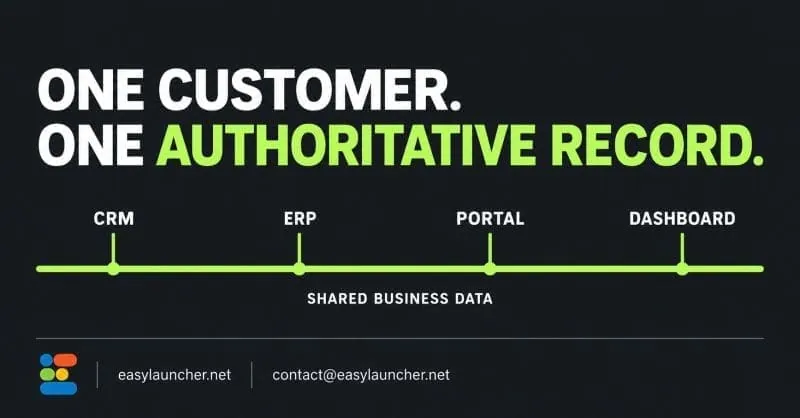
Figure 1: One Customer, One Authoritative Record: Portals and dashboards provide tailored interfaces over unified, authoritative business data, rather than maintaining isolated competing records.
The 4 Architectural Decisions Before Building Portals
Solving multi-system divergence does not require abandoning modern microservices or building monolithic databases. Instead, resilient system design starts with four explicit, non-negotiable architectural decisions.
1. Authority: Which System Owns Each Type of Information?
In distributed systems, authority cannot be shared equally. If both the customer portal and the internal ERP allow unrestricted writes to a tax identification number or credit term, eventual divergence is mathematically guaranteed.
Architects must establish a field-level Authority Matrix across the enterprise:
- Customer Legal Identity & Tax Status: Authoritatively owned by the ERP after formal compliance verification. The customer portal may submit an update request, but it acts as a submission client, not the final authority.
- User Authentication & Multi-Factor Credentials: Authoritatively owned by the centralized Identity Provider (Okta, Auth0, or Cognito). Neither CRM nor ERP should store portal passwords.
- Commercial Pipeline & Engagement History: Authoritatively owned by the CRM.
- Fulfillment & Warehouse Dispatch: Authoritatively owned by the Warehouse Management System (WMS).
When an application is designated as a client rather than an authority, its writes are routed as transactional proposals or events to the authoritative system of record, which validates and broadcasts the accepted state.
2. Movement: Should Updates Use APIs, Events, or Scheduled Synchronization?
A common anti-pattern in digital transformation is applying the same data transfer mechanism to every interaction. Engineering teams either default to synchronous REST APIs for everything (introducing tight coupling and cascading timeouts) or default to nightly batch cron jobs (introducing twelve-hour stale data windows).
Disciplined integration matches the data movement pattern to the functional requirement:
Synchronous APIs
Direct REST or GraphQL calls reserved for operations where immediate confirmation is mandatory for the user experience (e.g. credit card tokenization, password reset validation).
Latency: < 300ms | High CouplingEvent-Driven Streams
Publish-subscribe messaging (Kafka, AWS SNS/SQS, RabbitMQ) for transactional status changes. Decouples systems so that downstream outages never block the portal.
Latency: < 2s | Fault TolerantScheduled Sync
Batched synchronization pipelines for read-heavy analytical dashboards, aggregated financial summaries, and reporting data where real-time overhead is unjustified.
Cadence: Hourly/Daily | High Throughput3. Exceptions: What Happens When an Update Fails or Records Conflict?
In naive architectures, error handling is treated as an HTTP status code check: if an API returns 500, log it to standard error and display a generic alert to the user.
In production systems, conflict resolution requires explicit deterministic rules:
- Concurrent Modifications: If a customer changes their billing phone number in the portal while an account manager updates it in the CRM thirty seconds later, which change wins? Systems must employ optimistic locking, vector clocks, or deterministic field-level timestamp precedence rather than whole-row overwrites.
- Downstream System Outages: If the ERP is offline for weekend maintenance while a client submits an urgent order, does the portal reject the customer? Resilient architectures store the request in a durable transactional outbox queue with automated retries and dead-letter alerts.
- Validation Rejections: If the portal accepts an address format that the ERP tax calculation engine rejects, the record must enter a quarantined review state with an explicit notification to customer operations, not silently evaporate.
4. Traceability: Can the Team See What Changed, Where, and by Whom?
When an enterprise client asks why their billing currency switched from USD to EUR or why a shipment routed to an obsolete distribution center, nothing damages trust faster than an engineering team saying: “We cannot tell which system triggered the change.”
Traceability demands an immutable audit log across all integrated endpoints. Every state modification must carry standardized provenance headers:
correlation_id: Unique identifier spanning across API gateways, message queues, and database commits.actor_id&actor_role: Whether the update was initiated by the customer self-service user, an internal CRM specialist, or an automated batch worker.origin_system: The client application where the event originated (e.g.portal.v2vs.crm.salesforce).previous_state&new_state: The exact JSON delta of modified attributes.
Architectural Contrast: Shadow Data Silos vs. Governed Integration
The difference between building a fragile shadow silo and architecting a governed multi-system ecosystem is evident in how teams handle state, communication, and failure:
| Architecture Attribute | Shadow Silo Anti-Pattern | Governed Authoritative Design |
|---|---|---|
| Data Ownership | Shared indiscriminately; portal and internal apps each write to local copies | Strict field-level authority matrix; one system owns canonical state per domain |
| Integration Model | Ad-hoc point-to-point scripts and brittle cron polling | Event-driven publish-subscribe with transactional outbox pattern |
| Conflict Resolution | Last-write-wins; silent whole-record data overwriting | Optimistic locking, timestamp vectors, and explicit quarantine queues |
| Audit Trail | Scattered in isolated application logs; no global correlation | Centralized immutable audit stream with correlation IDs and origin actor tagging |
| System Coupling | High; portal crashes or freezes when backend ERP experiences downtime | Decoupled; asynchronous command queues preserve portal availability during outages |
| Role of AI | Unconstrained autonomous agents making silent database updates | AI parses ambiguous input and prioritizes exceptions under human oversight |
The Business Consequence of Delay: Real-Time vs. Eventual Consistency
Engineering discussions around system integration frequently get bogged down in academic debates over “real-time” requirements. Stakeholders often assume that every piece of data must synchronize instantaneously across every database.
In reality, the optimal synchronisation cadence should directly reflect the business consequence of delay:
- High-Consequence Latency (Immediate Synchronisation Required): Real-time available-to-promise inventory levels in e-commerce, credit card pre-authorizations, or medical prescription approvals. If inventory is delayed by ten seconds during a flash sale, multiple customers buy the same stock, creating back-order chaos.
- Moderate-Consequence Latency (Sub-Minute Synchronisation): Customer profile address updates or support ticket state transitions. A two-second propagation delay between the portal and CRM has zero commercial impact as long as eventual consistency is guaranteed.
- Low-Consequence Latency (Hourly or Daily Batch): Executive KPI rollups, predictive churn scores, and quarterly customer analytics dashboards. Forcing analytical aggregations through sub-second streaming pipelines adds massive architectural complexity without delivering incremental business value.
By categorizing data entities according to the true cost of latency, organizations eliminate over-engineered synchronous bottlenecks while ensuring critical operational rails remain rock-solid.
AI in Multi-System Architecture: Intelligent Triage, Not Unaccountable Authority
With the rise of generative AI and autonomous agents, many enterprise teams are tempted to delegate multi-system reconciliation to large language models. The thinking is intuitive: “Let the AI compare the customer record in the CRM with the portal input and merge the differences.”
This is an architectural trap. Probabilistic models are inherently non-deterministic. An AI agent should never be permitted to silently decide which database record is authoritative. If an AI hallucinates a business rule or misinterprets an address edge-case, it introduces corrupt state directly into your financial core without human detection.
Instead, modern systems design places AI into two tightly governed roles:
Input Parsing & Normalization
AI excels at parsing messy, unstructured human inputs: translating messy address strings into standardized postal formats, extracting tax IDs from scanned PDF certificates, or detecting duplicate company names across international spellings.
Exception Prioritization & Routing
When two systems conflict, AI scores the severity of the variance and routes the dispute to the specific business owner with summarized context, proposed reconciliation options, and confidence scores.
Authority remains a deterministic business decision supported by explicit corporate rules and accountable human owners. AI serves as the accelerator, not the judge.
Operational Paradigm: Multi-Facility Billing and Profile Synchronization
To understand the impact of authoritative architecture, consider a national industrial logistics enterprise operating across 24 regional warehouse hubs.
The organization had launched an impressive React-based customer portal allowing enterprise clients to schedule freight dispatches, manage billing contacts, and review warehouse inventory. However, each warehouse hub ran an independent local ERP instance, while corporate finance operated a centralized NetSuite deployment.
Because the customer portal saved profile changes into its own PostgreSQL cluster and synced asynchronously via point-to-point cron jobs:
- Over 14% of monthly freight billing invoices had mismatched billing entities or expired tax exemption certificates.
- Regional warehouse dispatchers frequently held trucks at loading docks because local billing records showed credit holds that the client had already resolved via the portal.
- Financial controllers spent over 200 staff hours each month manually cross-referencing CSV exports between the portal, Salesforce, and NetSuite.
The EasyLauncher integration team redesigned the multi-system flow using an authoritative event-driven pattern:
- Centralized Authority in NetSuite: The corporate ERP was formally designated as the single source of truth for commercial billing entities and credit thresholds.
- Portal as Proposal Engine: When a customer submits updated corporate details in the portal, the portal writes a pending update event to an Amazon EventBridge bus.
- Deterministic Rule Evaluation: Low-risk updates (e.g. secondary email notifications) are automatically committed to NetSuite and broadcast downstream. High-risk updates (e.g. tax ID changes or credit limit requests) trigger an automated task for the finance compliance officer with pre-validated data.
- Fan-Out Event Synchronization: Once approved, the ERP emits a canonical
CustomerProfileUpdatedevent. Regional warehouse databases, Salesforce, and the portal read replicas update in sub-second intervals.
The outcome: billing disputes decreased by 92%, truck dispatch delays due to credit mismatch dropped to zero, and the enterprise reclaimed hundreds of operational hours every month.
The Executive Takeaway: One Customer, One Authoritative Record
Building custom software, modern portals, and AI-enabled dashboards is essential for modern enterprise competitiveness. But great software is defined by the integrity of the underlying business architecture, not just the polish of the user interface.
Before rolling out your next customer application or internal portal, assemble your technical leads and business stakeholders around a single question:
The Two-System Litmus Test
“If two systems disagree tomorrow morning, which one wins, and will your team know why?”
If the answer relies on manual human memory, private Slack debates, or who ran a database update last, your architecture has a structural defect waiting to trigger an operational crisis.
Designate your authorities. Match movement to business risk. Govern your exceptions deterministically. When you architect for authoritative truth, your custom software becomes an enduring competitive engine rather than another reconciliation burden.
Eliminate Reconciliation Friction Across Your Enterprise Stack
Whether you are engineering a customer self-service portal, integrating ERP with modern SaaS tools, or untangling competing databases, EasyLauncher designs resilient, authoritative systems that scale without chaos.
Related Insights & Solutions
Continue exploring how we engineer resilient, high-performance technology.