Extracted Is Not Ready to Use: Why Document AI Fails Without Exception Architecture
An AI model can read an invoice, receipt, or bill of lading with 99% optical accuracy and still trigger catastrophic business errors. Transforming unformatted PDFs into structured JSON is only the intake step. If your architecture treats extraction as completion, you have not automated a workflow: you have merely automated the injection of unvalidated data into your core ledger.

The Illusion of Accuracy in Document AI
Enterprise engineering teams and IT executives frequently celebrate milestone vendor benchmarks: “Our vision model achieves 98.6% character-level accuracy across multilingual PDF invoices.” Vendor sales decks showcase side-by-side bounding boxes highlighting invoice numbers, line-item quantities, and vendor addresses with pixel-perfect precision.
Yet three months after launching the automated document pipeline, the accounting and operations departments are overwhelmed with reconciliation tickets:
- Vendor payments were automatically disbursed twice because an identical invoice was submitted with a slightly different file name.
- Billed amounts matched the total on the paper, but exceeded the contracted purchase order (PO) cap agreed upon six weeks earlier.
- A customer address was parsed perfectly, but pointed to a warehouse location decommissioned two quarters ago.
- Financial controllers spent more hours manually reversing journal entries than they previously spent keying in receipts.
The cognitive failure was not in the machine vision model or the language model parser. The parser did exactly what it was programmed to do: it converted visual symbols into alphanumeric strings. The breakdown occurred because the system architects conflated data extraction with business readiness.
“An AI system can read an invoice with flawless precision and still approve the wrong payment. The real expense in document workflows never sits in extraction; it sits in unhandled exceptions.”
EasyLauncher Intelligent Automation PracticeExtracted vs. Ready to Use: The Vital Distinction
Consider a standard accounts payable scenario. A supplier submits an invoice for $48,500.00. The Document AI microservice extracts the supplier name (“Apex Logistics Ltd”), the invoice number (“INV-2026-9041”), the line-item total, and the payment due date. Every extracted character matches the original PDF down to the sub-cent.
In an extraction-centric paradigm, this record is serialized to JSON and immediately posted to the ERP accounts payable endpoint. But in the real world of business operations, three critical questions remain unanswered:
- Is this document authentic and unique? Has this specific invoice reference or hash already been processed under an alternative subsidiary billing account?
- Does the transaction conform to external contractual reality? Was there an approved purchase order for this delivery? Did the receiving warehouse confirm receipt of all 1,200 units, or did physical inspection accept only 950 units due to freight damage?
- What is the governance boundary for approval? Does the submitter have delegated authority to authorize this disbursement, or does it trigger an executive sign-off requirement under corporate governance rules?
Accurate extraction answers what was written on the paper. Only architectural validation determines whether what was written corresponds to a legally binding, commercially sound, and non-duplicate obligation.
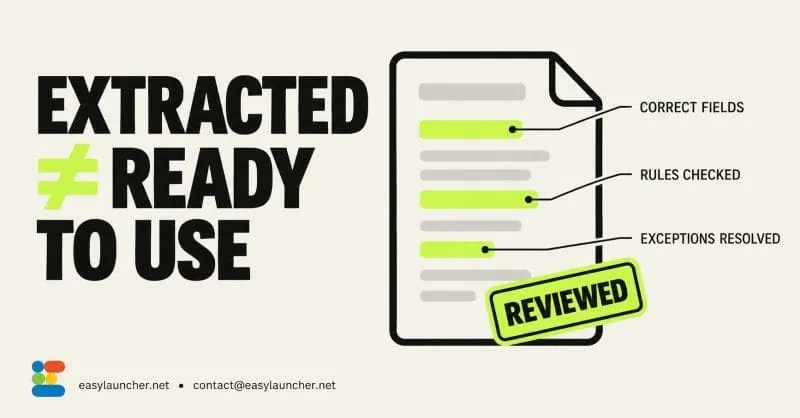
Figure 1: Extracted ≠ Ready to Use: Transforming document symbols into verified business records demands distinct extraction, validation, and human exception resolution tiers.
The Three-Job Architecture: Extract, Validate, Resolve
Production-grade document automation avoids monolithic pipelines where a single model or script is tasked with reading, evaluating, and writing data directly to production databases. Instead, resilient systems divide document processing into three decoupled, independently observable jobs:
1. Extract: Cognitive Intake & Confidence Calibration
The sole responsibility of the Extract stage is perceptual comprehension: interpreting raw pixels, scanned text, structured tables, and layout semantics into normalized key-value data structures.
Crucially, modern document extraction must output calibrated per-field confidence scores alongside raw data. A naive OCR tool returns a string like "TOTAL: $10,000" without metadata. A resilient extraction layer returns the bounding box, page index, OCR token probability, and semantic extraction confidence. If a handwritten mark obscures a zero or if an address field is ambiguous, the extraction payload signals lowered certainty before downstream consumers inspect the payload.
2. Validate: Deterministic Guardrails & Systems of Record
The Validate stage is entirely deterministic. It does not use probabilistic machine learning to guess whether an invoice is valid. It applies rigorous, programmatic business rules against existing enterprise Systems of Record (SoR):
- Cryptographic & Semantic Deduplication: Calculating fingerprint hashes across vendor tax IDs, invoice numbers, and billing amounts across rolling 24-month indices.
- Automated Three-Way Matching: Reconciling the invoice line items against active purchase orders and electronic goods receipt notes (GRNs) inside SAP, Oracle, or custom warehouse databases.
- Mathematical Integrity Checks: Verifying that line-item quantities multiplied by unit prices equal sub-totals, and sub-totals plus jurisdictional tax rates equal grand totals within rounding limits.
- Threshold Compliance: Confirming disbursement amounts against organizational Delegation of Authority (DoA) matrices.
If every assertion passes and extraction confidence exceeds configured thresholds, the record transitions directly to automated ledger entry. If any check fails, the record is immediately quarantined into an immutable exception state.
3. Resolve: Human-in-the-Loop Exception Routing
When an exception occurs, traditional automation either crashes, discards the payload into a generic dead-letter queue, or sends an unformatted error alert. Operators are forced to download the original PDF, locate the missing PO in another portal, compare numbers by hand, and re-enter everything from scratch.
In contrast, a governed exception architecture delivers a turnkey decision workspace to the designated business operator:
- The operator sees the exact visual crop of the document side-by-side with the conflicting enterprise record.
- The system explicitly flags the delta: “Invoice item #3 billed at $42.00/unit; PO #8192 contracted at $38.00/unit (Delta: +$4.00/unit across 500 units = $2,000 variance).”
- The operator is presented with unambiguous action buttons: Approve Price Variance (requires reason code), Reject with Vendor Notice, or Adjust to Contracted Cap.
By providing full contextual evidence at the point of decision, human review time drops from fifteen minutes of investigative digging to thirty seconds of informed adjudication.
Architectural Contrast: OCR Mindset vs. Systems Engineering
The difference between fragile OCR scripts and a resilient document processing system is reflected across every layer of the software stack:
| Dimension | OCR & Parser Mindset | Systems Engineering Architecture |
|---|---|---|
| Primary North Star Metric | Character recognition accuracy (OCR precision %) | Straight-Through Processing (STP) rate & zero downstream rework |
| Data Ingestion Model | Direct extract-to-database write operations | Staged state machine: Extract → Validate → Resolve → Commit |
| Duplicate Detection | Unchecked or basic file name matching | Deterministic composite hashing (Vendor ID + Amount + Date + Tax ID) |
| Cross-System Verification | None; treats document content as self-contained truth | Real-time reconciliation against ERP purchase orders, goods receipts, and bank rails |
| Handling Exceptions | Generic alerts sent via email; manual offline re-keying | Evidence-backed review console with bounding-box highlighting and one-click actions |
| Continuous Learning | Static models; human edits evaporate into closed systems | Human review decisions captured as structured ground-truth for prompt calibration and retraining |
The 3 Telemetry Metrics That Actually Matter
If you want to know whether your document automation project is actually delivering return on investment, stop measuring model extraction accuracy. Measure these three operational metrics instead:
Straight-Through Processing
The percentage of documents that pass from ingestion to final system-of-record synchronization without a single manual intervention or human touch.
Benchmark: 75% to 92% in mature enterprise flowsException Aging Time
The elapsed duration between an exception being flagged by validation rules and its resolution by an authorized human operator.
Target: < 4 business hours (down from days)Defect Escape Rate
How frequently a record that cleared automated validation requires post-hoc correction, credit note issuance, or manual ledger reversal.
Target: < 0.05% of all ingested volumeWhen an organization optimizes solely for extraction accuracy, downstream defect escape rates spike because ambiguous inputs are forced through without safety boundaries. When you architect for validation and exception resolution, Straight-Through Processing increases naturally, safely, and measurably.
Operational Paradigm: Three-Way Matching in Accounts Payable
Let us examine how this architecture operates in an enterprise logistics and freight brokerage handling 45,000 carrier invoices monthly.
Under their prior vendor-supplied OCR tool, the system achieved a 94% text extraction score. However, because rate sheets, fuel surcharges, and detention fees constantly fluctuated, over 22% of paid invoices harbored billing discrepancies. The accounting department maintained a permanent backlog of 1,800 disputed line items, causing strained carrier relationships and late payment penalties.
The EasyLauncher systems engineering team replaced the brittle pipeline with a decoupled three-job architecture:
- Multimodal Ingestion with Dynamic Schemas: A vision-language extraction layer parses unstructured PDF invoices, bills of lading, and weigh-scale tickets, outputting normalized line items with token confidence indices.
- Real-Time Contract Rule Evaluation: An asynchronous worker matches each line against the transportation management system (TMS) rate matrix. Fuel surcharge indices are dynamically pulled from government energy feeds; detention charges are verified against IoT GPS geofence timestamps recorded at loading docks.
- Evidence-Driven Human Resolution: When an unauthorized $350 detention charge appears on an invoice without supporting GPS dwell telemetry, the system creates an annotated dispute dossier. The carrier coordinator clicks a single button to dispatch a formal rate rejection citing the GPS entry-exit logs.
The operational impact was immediate: carrier payment cycle times dropped from 14 days to 48 hours, unauthorized fee leakages dropped by $420,000 annually, and the team achieved an 84% straight-through processing rate with complete financial auditability.
The Executive Takeaway: Design for the Exceptions
Building an effective document automation system is not a machine learning benchmark competition. In production, 80% of document layouts will be handled effortlessly by current foundational models. The true test of your technical architecture is how gracefully and safely it handles the remaining 20% that violate assumptions.
Before investing in custom model training or signing expensive document AI platform subscriptions, step back and examine your operating model:
- Are your business validation rules explicitly written down as code or locked inside employees' heads?
- Do your exception reviewers have instant visual evidence, or are they forced into multi-tab forensic investigations?
- Is your leadership dashboard tracking extraction percentage or downstream business outcomes?
AI can read your documents. Only deliberate systems architecture can turn them into reliable enterprise action.
Engineering High-Integrity Document & Intelligent Automation Pipelines
EasyLauncher designs and deploys mission-critical document intelligence, automated reconciliation engines, and custom enterprise workflows. From financial three-way matching to automated compliance intake, we architect systems that eliminate operational bottlenecks without sacrificing governance.
Related Insights & Solutions
Continue exploring how we engineer resilient, high-performance technology.