Use the Least Complex Tool That Works: The 4-Layer Architecture for Enterprise AI
When Databricks released ai_decide, it highlighted an architectural truth every engineering team eventually learns the hard way: routing every operational step to a massive generative model is a recipe for high latency, runaway token bills, and brittle workflows. Resilient enterprise intelligence requires a disciplined 4-layer architecture.

The Trap of the Generative Monolith
Over the past two years, enterprise engineering teams rushed to solve business automation by wrapping massive frontier Large Language Models (LLMs) around entire business workflows. The initial demonstration was always mesmerizing: an engineer prompted a single model to parse customer correspondence, validate identity fields, determine refund eligibility, calculate discounts, write a personalized apology, and commit updates to the CRM.
Yet once these monolithic prompt pipelines met real production traffic, reality set in:
- Crippling Latency: Passing thousands of tokens through a 100B+ parameter generative model introduces 1,500 to 4,000 milliseconds of round-trip overhead for operations that standard software solves in under 5 milliseconds.
- Compounding Token Costs: Paying token fees on every routine customer identification, status ping, and boolean check burns operational capital on tasks that require zero creative reasoning.
- Stochastic Fragility: A generative model instructed to return strict JSON or classify intent can intermittently hallucinate novel enum values, ignore formatting instructions, or misinterpret standard mathematical constraints.
- Audit Impossibility: When an auditor or compliance officer asks why a specific customer credit was rejected, explaining that a proprietary 70-billion-parameter model hallucinated a negative tone in the inquiry is legally and operationally indefensible.
“Do not send every step to the largest available model. Use the least complex tool that works.”
EasyLauncher Enterprise AI PracticeThe Lesson of ai_decide: Decisions vs. Generation
On September 30, Databricks announced the public beta of ai_decide: a purpose-built SQL function engineered specifically to turn unstructured text into structured decisions. Rather than firing an open-ended conversational completion request, ai_decide evaluates inputs against explicit candidate categories, scoring thresholds, and classification targets.
Databricks reported that for classification, routing, and agent evaluation tasks, specialized decision execution provides dramatically lower latency and compute cost than invoking a generative model.
The broader takeaway goes far beyond any individual cloud vendor or SQL dialect: a decision is not a generation. Asking a system “Which department handles this ticket?” requires categorization, not creative writing. Treating decision-making as an open-ended generative task introduces massive computational waste and non-deterministic risk.
The 4-Layer Architecture Framework
To build intelligent systems that scale reliably without bankrupting operational budgets, enterprise architects should organize workload pipelines into four distinct execution layers. Each layer handles only the specific responsibility it is structurally optimized to perform:
Layer 1: Deterministic Rules (Known Logic & Invariants)
If an outcome can be computed with a database query, regular expression, schema validator, or binary state machine, it belongs in Layer 1. Code written in TypeScript, Go, Python, or SQL executes in microseconds, costs fractions of a cent per million invocations, and produces identical results every time.
Ideal Workloads for Layer 1:
- Validating customer account IDs, email syntax, and session tokens.
- Enforcing business authorization tiers, rate limits, and discount caps.
- Calculating billing sums, tax amounts, and timestamp differences.
- Direct transactional database mutations and idempotent webhook dispatching.
Layer 2: Decision Models (Classify, Score & Route)
When incoming data is unstructured (such as raw customer emails, bug reports, or support tickets), deterministic regex rules become brittle. However, you still do not need a creative text generator. You need a structured classifier.
Layer 2 uses specialized classification models, embedding cosine similarity, or structured decision endpoints (like Databricks ai_decide or small encoder architectures). These models output discrete enums, confidence vectors, and routing keys with predictable latency and zero token generation variance.
Ideal Workloads for Layer 2:
- Intent classification (e.g. Billing Dispute, Technical Outage, Feature Request).
- Urgency scoring and SLA priority tier assignment.
- Model router gates: determining whether an inquiry requires a lightweight model or a frontier reasoning model.
- Evaluating agent response guardrails for safety and policy compliance.
Layer 3: Generative Models (Create & Reason)
Only once business constraints have been verified and inputs categorized does a generative model enter the pipeline. Large language models excel at semantic synthesis: translating structured database outputs into clear, empathetic prose, summarizing multi-page diagnostic logs, or generating contextual draft replies.
Because Layer 1 and Layer 2 already validated all business rules and classified the request, the generative model receives a clean, tightly scoped context window. It does not need to guess account balances, calculate refunds, or determine policy limits; it simply composes the explanation using the verified data provided.
Ideal Workloads for Layer 3:
- Drafting tailored, empathetic customer support communications.
- Synthesizing multi-source documentation into structured technical answers.
- Translating user requirements into domain-specific configuration scripts.
- Summarizing complex incident timelines across multiple telemetry channels.
Layer 4: Human Review (High Consequence & Ambiguity)
Full autonomy is neither an architectural requirement nor a prudent business goal for high-stakes enterprise decisions. Consequential operations (such as approving non-standard refunds, terminating client contracts, issuing credit notes, or modifying access controls) must route to designated human supervisors.
Layer 4 is not a manual bottleneck; it is an engineered escalation gateway. Because Layers 1 through 3 have already extracted the relevant details, classified the urgency, and drafted the recommended resolution, human reviewers can inspect the full context in seconds and approve or adjust with one click.
Ideal Workloads for Layer 4:
- Approving financial disbursements or credit overrides above established thresholds.
- Resolving edge-case inquiries where Layer 2 classification confidence fell below 85%.
- Reviewing disciplinary, legal, or regulatory compliance disclosures.
- Auditing sampled automated resolutions for quality assurance and continuous model calibration.
Blueprint: Least Complex Tool That Works
The core operational principle is sequential filtering: each tier handles what it does best and passes only unresolved complexity downstream.
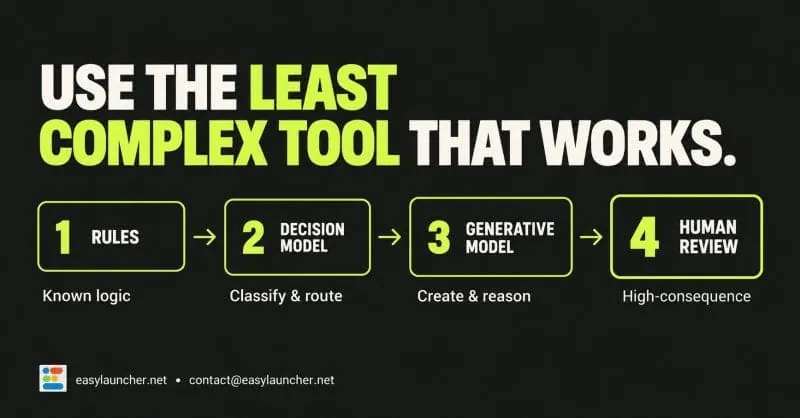
Figure 1: The 4-Layer Architecture: Match each operational step with the minimum necessary level of cognitive complexity.
Operational Matrix: Comparing the 4 Tiers
Evaluating the engineering characteristics of each layer clarifies why mixing responsibilities causes instability:
| Layer | Primary Role | Latency Profile | Cost Profile | Determinism | Auditability |
|---|---|---|---|---|---|
| 1. Rules | Known logic & schema constraints | < 10 ms | Near zero ($0.000001) | 100% Deterministic | Direct unit tests & SQL logs |
| 2. Decision Models | Classify, score, semantic routing | 30 to 120 ms | Micro-cent per call | Bounded enum set | Confidence vector metrics |
| 3. Generative Models | Language synthesis & reasoning | 800 to 3,500 ms | Token-based pricing | Stochastic (needs schema guards) | Prompt & completion tracing |
| 4. Human Review | High-consequence approvals | Minutes to hours | Staff operational time | Human judgment | Signed role audit trail |
Production Case: Customer Support & Claims Automation
To illustrate how this architecture operates in practice, consider an enterprise customer-support pipeline receiving thousands of incoming inquiries daily, ranging from simple password resets to disputed charges and warranty claims.
Step 1: Ingestion & Validation (Rules Layer)
The webhook receives the payload. Conventional software validates that the sender possesses an active account, extracts the user ID, verifies subscription tier, and queries the database for recent order history. If the ticket is a duplicate submission within 60 seconds, a deterministic idempotency rule rejects it immediately without calling any AI model.
Step 2: Semantic Intent & Routing (Decision Model Layer)
A fast decision model (such as an intent classifier or ai_decide) evaluates the unstructured text. It classifies the category as Damaged Goods in Transit, assigns a sentiment score, and flags the claim amount. Because confidence is 96%, it selects the “Standard Replacement Claim” pipeline.
Step 3: Response Drafting (Generative Model Layer)
A generative LLM receives the customer name, order number, replacement tracking link, and the classified claim details in its prompt context. It composes a warm, natural email acknowledging the damaged delivery and explaining that a replacement has already been dispatched.
Step 4: Exception & Authorization Gate (Human Review Layer)
If the replacement item value is under $100 and the customer has zero past abuse flags, Layer 1 automatically dispatches the shipment. But if the claim involves an enterprise server rack valued at $4,500, Layer 1 intercepts the workflow and sends the drafted resolution to a customer support lead for one-click approval before any warehouse dispatch occurs.
Notice what happens when each component does only what it handles best: 80% of low-risk tickets resolve in milliseconds without human intervention, token costs remain strictly controlled, and high-dollar exceptions never execute without explicit executive authorization.
The 4 Questions Before Selecting a Model
Before your team writes a prompt, configures an agentic framework, or spins up a GPU cluster, evaluate each step in your target workflow against these four architectural questions:
1. Does this step require language generation or semantic creativity?
If the output is a boolean, an enum, a category, or a score, do not invoke a generative LLM. Use a decision model or deterministic rules engine. Reserve generative models strictly for tasks that require synthesizing language, code, or context.
2. Can this condition be proven with existing database state or fixed logic?
Never ask an AI model whether a user has enough account balance, whether a product is in stock, or whether a discount code is expired. Query your authoritative System of Record directly with deterministic code.
3. What happens if this step fails or hallucinates?
If failure results in erroneous fund transfers, data deletion, compliance violations, or reputational damage, the step cannot run autonomously on open-ended models. It requires deterministic constraints and human sign-off gates.
4. Could this step be solved with a model ten times smaller?
Routing a sentiment check or category tag to a 400B parameter frontier model is architectural malpractice. Benchmark smaller fine-tuned encoders, quantized local models, or decision primitives. You will routinely cut latency by 90% and compute bills by 95%.
The Executive Takeaway: Minimum Viable Cognitive Overhead
The ultimate measure of engineering maturity in AI is not how many complex models your stack invokes. It is how much value your architecture delivers with the minimum required cognitive overhead.
Conventional automation remains one of the most powerful competitive advantages in software engineering. When you combine deterministic code for known rules, specialized models for routing decisions, generative intelligence for creative synthesis, and humans for high-stakes oversight, you build an AI system that is economical, compliant, blazingly fast, and built to last.
Architecting Production-Grade Enterprise AI
At EasyLauncher, our principal AI engineers and systems architects design resilient, multi-tiered automation platforms: from sub-millisecond decision routers to full-scale conversational voicebots and automated KYC pipelines.
Related Insights & Solutions
Continue exploring how we engineer resilient, high-performance technology.