Model Choice Is Not Model Portability: The Application Contract for Multi-Model Enterprise AI
Cloud platforms are making it effortless to provision dozens of foundational models inside a single console. But access alone does not equal model portability. Without a rigorous application contract spanning evaluation, routing, and observability, switching models in production remains a costly rebuild.

The Illusion of Open Model Gardens
On October 21, OpenAI and Google Cloud announced that OpenAI models and Codex workflows are coming directly to Google Cloud Model Garden. Enterprise customers began receiving private-preview access, with general ecosystem availability scheduled to follow. In parallel, major cloud providers like AWS Bedrock and Microsoft Azure AI Foundry continue expanding their catalogs to include open weights, fine-tuned checkpoints, and rival proprietary models side by side.
The industry headline was immediate: enterprises can now choose any model anywhere. The verified reality, however, is narrower. Cloud vendors have successfully consolidated model procurement and billing into their unified enterprise agreements. You can now invoice OpenAI, Anthropic, Meta Llama, and Google Gemini through the same cloud subscription.
Yet access does not create portability. Procuring two models through the same cloud console does nothing to shield your codebase from the engineering friction of switching between them.
“Model choice is getting easier. Model switching is not. Having three models available in your cloud console does not mean your application can survive swapping them tomorrow.”
EasyLauncher Enterprise AI PracticeThe Switching Tax: Why Swapping Models Breaks Production
To understand why model switching remains punishing, consider an enterprise customer-support assistant or automated dispute engine built over the past year. On paper, it is merely calling a completion endpoint. In practice, the system has gradually formed deep, implicit dependencies on one specific provider:
Prompt Sensitivity & Steering
System prompts are painstakingly calibrated to one model quirks. Phrasing that elicits reliable multi-step chain-of-thought in GPT-4o might cause Gemini 1.5 Pro to over-explain or Claude 3.5 Sonnet to skip explicit schema formatting.
Function Calling & Schema Divergence
Tool definitions, parameter constraints, and parallel execution flags differ markedly across SDKs. Swapping the backend often causes JSON schema validations to fail when the alternate model returns null values or nested strings unexpectedly.
Safety Filter Asymmetry
Vendor guardrail triggers are not standardized. An enterprise underwriting workflow that passes smoothly through one provider moderation endpoint may trigger false-positive policy blocks on another, silently breaking user transactions.
Telemetry & Cost Blindspots
Token counting, cache hit ratios, and latency profiles vary widely. Without a unified telemetry layer, billing dashboards fragment, making cross-provider cost governance and SLA attribution impossible to audit.
When an engineering team attempts to swap models under these conditions, it is not a 5-minute configuration change. It becomes a multi-week initiative involving prompt rewrites, custom schema mappings, extensive manual smoke tests, and revised monitoring alerts.
The Application Contract Framework
True model portability is not achieved by installing an open-source proxy package and calling it done. Portability is an architectural discipline. It requires establishing a stable Application Contract that isolates your business logic from underlying foundational models across three core pillars:
Pillar 1: Continuous Evaluation (Your Real Contract)
In traditional software engineering, an API contract is enforced by automated unit tests and integration suites. In AI systems, public leaderboard scores (MMLU, HumanEval, Chatbot Arena) are virtually meaningless for your operational domain.
A portable application maintains its own private, reproducible evaluation dataset composed of:
- Real production queries with anonymized inputs reflecting edge cases and domain vernacular.
- Deterministic assertions on structured outputs (JSON schema compliance, mandatory key presence, type validation).
- Ground-truth semantic rubrics scoring factual grounding, hallucination rate, and policy adherence.
Before any model can be substituted in production, it must execute against this automated evaluation harness. If Model B scores 99% on schema compliance and maintains 94% semantic precision at 40% lower token cost, the change is verified by data, not guesswork.
Pillar 2: Intent-Driven Routing & Resilient Fallback
A single fixed endpoint creates a single point of operational and commercial failure. When an enterprise relies on one provider, an unexpected outage or rate limit degradation immediately halts customer workflows.
A resilient application contract implements a dynamic routing gateway:
- Task-Specific Dispatch: Route routine categorization and sentiment tagging to fast, cost-efficient small models (e.g. GPT-4o-mini, Claude Haiku), reserving high-parameter reasoning models exclusively for complex edge cases as outlined in our 4-layer architecture framework.
- Deterministic Circuit Breaking: If the primary provider latency spikes above 2,500ms or returns consecutive HTTP 503 errors, automatically degrade or route to a secondary pre-warmed provider without user-facing interruptions.
- Unified Schema Normalization: The gateway accepts one standardized request envelope and serializes it into the target provider dialect, mapping tool calls and function returns transparently.
Pillar 3: Unified Observability & Cost Telemetry
You cannot manage what you cannot measure uniformly. Relying on provider-specific dashboards creates operational blindness. When one team member reviews usage in Google Cloud Vertex AI, another checks OpenAI platform logs, and a third inspects Azure billing reports, unified cost governance is impossible.
A production-grade application contract logs every interaction into a unified observability pipeline tracking four critical signals:
Blueprint: Decoupling Application from Provider
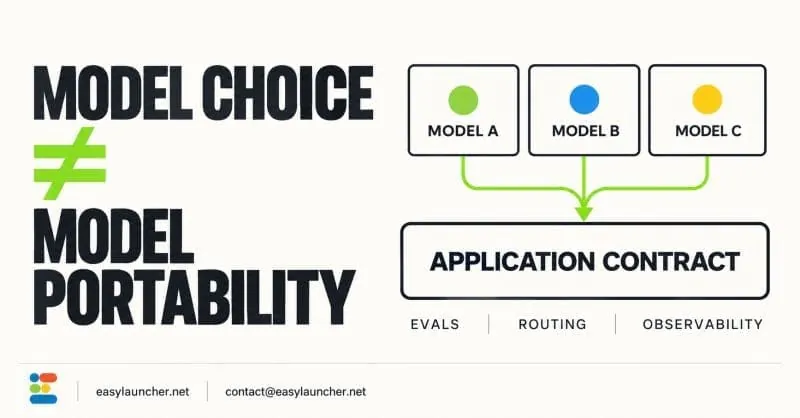
The infographic below illustrates the difference between model choice and model portability. While cloud vendors offer parallel model options (Model A, Model B, Model C), true independence requires a unified Application Contract layer managing evals, routing, and observability:
Comparison Matrix: Locked-In vs. Contract-Decoupled AI
How does a coupled system compare against an architecture designed with an explicit application contract? The operational differences emerge rapidly during production incidents and vendor renegotiations:
| Architectural Dimension | Tightly Coupled (Vendor-Locked) | Decoupled (Application Contract) |
|---|---|---|
| Model Switching Mechanism | Code refactoring, prompt re-engineering, SDK migration. | Configuration change verified against automated evals. |
| Failover & Availability | Direct hard failure when provider suffers rate limit or outage. | Automated fallback to secondary provider with pre-aligned schemas. |
| Prompt & Tool Management | Embedded directly into vendor-specific API structures. | Vendor-neutral prompt templates with canonical tool definitions. |
| Quality Verification | Manual testing and anecdotal engineering feedback. | Continuous CI/CD eval benchmarks testing regressions before rollout. |
| Commercial Leverage | Zero leverage; locked into annual contract pricing. | High leverage; ability to route traffic to best price-performance ratio. |
The Architect’s Dilemma: When Do You Actually Need Portability?
A common trap for engineering teams is premature generalization. Building a multi-provider gateway with automated eval suites, circuit breakers, and canonical tool schemas requires real engineering investment.
Not every application needs multiple models. If your application is an internal knowledge base helper or a prototype with modest throughput and relaxed uptime SLAs, a single reliable provider endpoint is perfectly sufficient. Adding an orchestration layer to a single-use tool creates architectural complexity without delivering business value.
However, portability transitions from an optional luxury to an architectural necessity when any of the following four criteria apply:
Strict Uptime SLAs & High-Volume Operations
When downtime or prolonged API throttling carries substantial financial penalties, multi-provider active-active routing is the only defensible resilience strategy.
Cost Optimization & Margin Protection
When processing millions of tokens weekly, the ability to route 80% of classification and parsing traffic to small models saving 10x per request protects corporate operating margins.
Data Sovereignty & Regulatory Compliance
European GDPR, financial sector regulations, or healthcare data boundaries often dictate that specific customer records must be processed within distinct geographical regions or air-gapped sovereign cloud partitions.
Rapid Model Evolution Cycles
The frontier model performance leaderboard turns over every 60 to 90 days. An organization structured to swap models via configuration captures performance and price benefits immediately, while competitors remain bogged down in multi-month migrations.
Production Scenario: Multi-Provider Customer Support Agent
Consider a Tier-1 customer support platform handling billing queries, subscription upgrades, and transaction disputes across 250,000 monthly interactions. Here is how a disciplined application contract operates in practice:
interface ModelContractRequest {
  intent: "support_triage" | "account_resolution" | "refund_calculation";
  canonicalPrompt: PromptTemplate;
  tools: CanonicalToolDefinition[];
  safetyProfile: "enterprise_strict" | "standard";
  constraints: {
    maxLatencyMs: 1200;
    maxCostPerCallCents: 0.05;
    requiredSchemaVersion: "2026.10";
  };
}

// Router executes intent matching and fallback policy
async function executeContract(req: ModelContractRequest): Promise<ContractResponse> {
  const targetRoute = Router.selectOptimalProvider(req.intent, req.constraints);

  try {
    return await targetRoute.execute(req);
  } catch (error) {
    Telemetry.recordFailure(targetRoute.provider, error);
    return await Router.fallbackRoute(req).execute(req);
  }
}
Notice what this design achieves: the customer support business logic never imports a vendor SDK directly. It defines its requirements in terms of intent, canonical tools, and constraints. When OpenAI models became accessible via Google Cloud Model Garden, the operations team did not rewrite the support agent. They registered the new Google Cloud endpoint into the router, validated it against their 500-case evaluation suite, and transitioned traffic safely in one deployment.
The 5-Point Portability Audit
Before your team builds its next AI workflow, ask these five fundamental architectural questions:
1. Where Do Prompts and Schemas Live?
Are prompt templates and tool definitions stored in vendor-agnostic repositories, or are they coupled to proprietary SDK parameters?
2. Do You Own an Automated Evaluation Harness?
Can your CI pipeline automatically run 200 real task cases against a candidate model and output an objective pass/fail score within 15 minutes?
3. Is Fallback Routing Active or Hypothetical?
If your primary provider encounters a 30-minute global API degradation, does your system automatically fail over, or does your service shut down?
4. Is Observability Standardized Across Providers?
Can engineering leadership compare real-world latency, token consumption, and cost per workflow across multiple model providers in a single dashboard?
5. Can You Switch Models Through Configuration?
If a breakthrough model launches tomorrow morning with half the latency and a third of the cost, can you switch in under 2 hours without pushing code?
The Executive Takeaway: Portability Is an Architectural Choice
The consolidation of foundation models across major cloud ecosystems like Google Cloud Model Garden, AWS Bedrock, and Azure AI Foundry is a welcomed operational milestone. It streamlines enterprise procurement and simplifies security boundaries.
However, convenience of procurement must not be confused with resilience of architecture. True independence comes from defining an explicit application contract around your business logic. When you own your evaluation benchmarks, govern your routing layer, and capture unified telemetry, model choice is no longer an illusion: it is your greatest competitive advantage.
Architecting Multi-Model Enterprise AI
Whether you are evaluating cloud foundation models, designing high-resilience routing gateways, or setting up automated evaluation harnesses for enterprise workloads, EasyLauncher provides hands-on engineering and architectural consulting.
Related Insights & Solutions
Continue exploring how we engineer resilient, high-performance technology.