Streaming Quality Is a Chain: Why Playback Fails When Dashboards Are Green
A viewer presses play once. Your streaming architecture must succeed across five distinct systems in milliseconds. When video buffers or drops out, the player or the CDN usually takes the blame, but the root failure often started four hops earlier. Here is how media platforms shift from isolated component monitoring to unified delivery chain reliability.

The Illusion of the Five Green Dashboards
In high-scale video streaming, there is a recurring operations room nightmare. Thousands of concurrent viewers in a prime broadcast market begin encountering infinite loading spinners, frame drops, or total playback aborts. The operations console is checked immediately.
The source ingest health widget reads green. The live transcoding cluster reports 0% CPU starvation. The packagers are successfully writing fragmented MP4 files into object storage. The global Content Delivery Network (CDN) reports a 99.8% cache hit ratio and sub-10ms edge responses. Even the client application health check returns a steady HTTP 200 OK.
Five independent teams look at five independent dashboards, and all five report perfect health. Yet for tens of thousands of subscribers on living room smart TVs and mobile devices, the stream is dead.
The paradox arises because streaming video is not a monolithic application service: it is a tightly coupled chronological pipeline. A viewer presses play a single time, but the platform must uphold five sequential contracts without a single timing or cryptographic deviation. When monitoring tools measure whether individual servers are running rather than whether the playback chain can deliver an intact frame, engineering teams operate blind.
“The better operational question is not simply, ‘Are the servers running?’ It is: ‘Can this viewer receive a usable stream right now?’”
EasyLauncher Media Infrastructure PracticeThe 5 System Promises in Every Stream
From contribution camera to glass screen, video passes through five distinct domains. Each stage carries a specific technical promise. If any link in the chain breaks that contract, downstream stages amplify the error until playback crashes.
1. Source: Ingest Signal Integrity (The Promise of Signal)
The pipeline starts with the contribution feed, received via protocols such as SRT (Secure Reliable Transport), RTMP, or uncompressed SMPTE ST 2110 IP video. The promise of the source layer is absolute signal completeness, stable clock timing, and consistent uncorrupted audio-video synchronization.
When an uplink experiences jitter, micro-packet bursts, or dropped Presentation Timestamps (PTS), the ingestion gateway may keep running without throwing a process crash. However, the downstream transcoder receives gap-ridden timecodes that force it to re-initialize clocks or drop audio frames, sowing the seeds of desynchronization.
Critical Telemetry for Ingest:
- SRT Round Trip Time (RTT), packet retransmit percentage, and jitter buffer headroom.
- Continuous PCR/PTS/DTS clock continuity and delta validation.
- Audio channel phase alignment, loudness standards, and dropped frame counters.
2. Transcode: Synchronized Timing and GOP Alignment (The Promise of Timing)
Adaptive Bitrate (ABR) streaming requires splitting video into multiple renditions (from 1080p60 down to 360p30). The non-negotiable contract of the transcoding tier is strict Group of Pictures (GOP) alignment: every single rendition must produce instantaneous decoder refresh (IDR) keyframes at the exact same presentation timestamp.
If a hardware encoder drops a single frame on the 720p variant but keeps cadence on the 1080p variant, their keyframes drift by 33 milliseconds. The server metrics show zero errors. But when a mobile viewer moves from cellular to Wi-Fi and shifts renditions, the player decoder cannot map the frame transition and freezes on a black screen.
Critical Telemetry for Transcoding:
- Keyframe cadence drift across all parallel ladder rungs (±0 frame tolerance).
- Real-time encoding speed factor (must remain strictly > 1.0x with zero throttling).
- VMAF and PSNR perceptual quality scoring per encoding instance.
3. Package & DRM: Manifest Assembly and License Access (The Promise of Access)
The packaging engine segments continuous elementary streams into Common Media Application Format (CMAF) fragments, generates HLS multivariant playlists and MPEG-DASH MPD manifests, and applies Common Encryption (cenc / cbcs) for Widevine, FairPlay, and PlayReady DRM systems.
The contract here is timely manifest updates and seamless key server authorization. If an SCTE-35 ad-insertion splice cue has an offset calculation mismatch, or if a DRM key rotation cycle fires 500ms before client license tokens are renewed, playback aborts immediately. The packaging server wrote valid files, yet the viewer was locked out.
Critical Telemetry for Packaging and Security:
- DRM Key Acquisition Service (KAS) P99 latency and license issuance success rate.
- SCTE-35 cue injection validation and segment boundary alignment.
- Live sliding-window manifest refresh latency and Media Sequence Number continuity.
4. Delivery: Edge Reach and Origin Shielding (The Promise of Reach)
Video delivery networks must scale millions of concurrent segment downloads without collapsing the packaging origins. The promise of the delivery tier is low Time-to-First-Byte (TTFB), high edge cache hit ratios, and intelligent mid-tier shielding.
A common delivery failure occurs when CDN edge caches mistakenly cache live playlist manifests with standard VOD cache headers (e.g., caching a 2-second live manifest for 30 seconds). The CDN proudly reports a 99.9% cache hit ratio and lightning-fast response times, while players receive stale manifests and starve for new segments, driving the rebuffering rate through the roof.
Critical Telemetry for CDN and Edge:
- Segment TTFB vs. Manifest TTFB tracked separately by geography and ISP.
- Origin Shield request collapse efficiency during peak viewer flash crowds.
- HTTP 404/410 segment loss anomalies across live sliding windows.
5. Player: Client Decoding and Recovery Experience (The Promise of Experience)
The player client sits on diverse hardware ecosystems: high-end OLED smart TVs, low-cost set-top boxes, browser engines with varying Media Source Extensions (MSE) implementations, and native mobile operating systems. The contract of the player is stable playback startup, defensive buffer management, and graceful recovery when networking dips.
If an upstream audio track switches codecs midway through a stream, or if segment size variation tricks the client Adaptive Bitrate (ABR) algorithm into aggressive bitrate oscillations, the viewer sees constant stuttering. The player is the only place where the five promises culminate into perceived human value.
Critical Telemetry for Client Experience:
- Time-to-First-Frame (TTFF) and Video Startup Failure (VSF) percentages.
- Rebuffer ratio (percentage of session time spent in rebuffering states).
- Hardware decoder crashes, dropped frame rates, and DRM decryption exceptions.
Architectural Blueprint: Streaming Quality as a Chain
The viewer experiences one screen, but the delivery chain must preserve continuity across five synchronized stages. When operational observability reflects this topology, cross-team finger-pointing disappears.
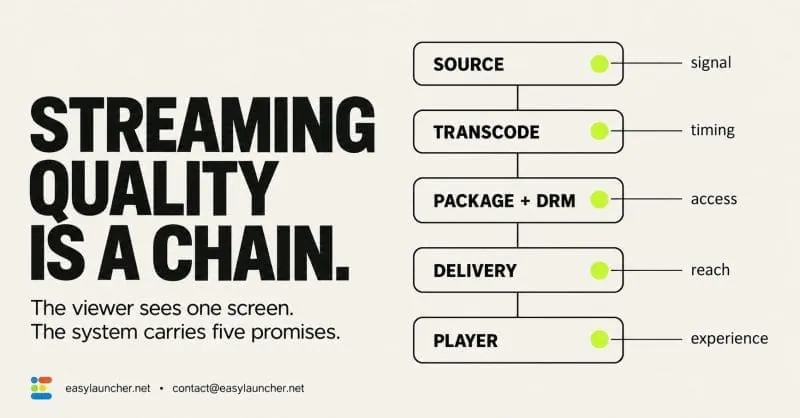
Figure 1: The 5 System Promises in Video Engineering: Each layer must fulfill its technical contract for the viewer to receive a dependable playback experience.
The Anatomy of a Silent Playback Outage
Consider a real incident encountered during a high-profile live sporting event broadcast to over 1.2 million concurrent users.
Ten minutes into the match, thousands of customer support tickets flooded social media channels complaining that streams were randomly freezing and restarting every 15 seconds. The Network Operations Center (NOC) performed immediate triage:
- CDN check: The CDN edge showed standard 200 HTTP response codes. Traffic was steady at 4.2 Tbps.
- Origin check: Origin shield nodes had negligible memory pressure and CPU utilization under 45%.
- Transcoder check: All video rungs were actively producing output segments without pipeline errors.
Because every system reported healthy metrics, engineers spent 40 minutes debating whether the issue was a regional ISP routing glitch or a faulty client app update.
The actual culprit? An automated linear ad-insertion system had injected an SCTE-35 splice message with an uncalibrated presentation timecode offset. The packager accepted the marker and split the video stream cleanly, but failed to write matching audio sample durations on the secondary language audio track.
When player audio/video clock decoders encountered the 120ms discrepancy between the audio sample and video PTS, the client Media Source Extensions buffer entered an unrecoverable stall. The servers had performed their tasks flawlessly according to their local specifications; the system failed because the contracts between the stages broke.
Operational Matrix: Component Metrics vs. Chain Telemetry
Traditional infrastructure monitoring tracks host-level metrics. Resilient media platforms monitor transaction continuity and end-to-end chain health:
| Delivery Stage | Isolated Component Metric (Traditional) | Correlated Chain Telemetry (Modern) | Viewer Risk Mitigated |
|---|---|---|---|
| Source Ingest | Process CPU, Ingest NIC bytes received | PCR/PTS jitter, SRT packet retransmits, audio phase drift | Micro-stutters, lip-sync lag, encoder clock stalls |
| Transcoding | Node cluster utilization, GPU memory | Multi-rendition IDR keyframe alignment, speed factor index | Decoder crashes during ABR bitrate switches |
| Packaging & DRM | HTTP 200 responses on license server | Key server P99 latency, SCTE-35 boundary splice delta | Black screen on playback launch, failed ad insertions |
| CDN Delivery | Global cache hit ratio, bandwidth volume | Manifest freshness delta, segment TTFB by ISP edge, 404 bursts | Stale playlist starvation, rebuffering spirals |
| Player Client | Crash reports, app store star ratings | Time-to-First-Frame, rebuffer ratio, playback failure rate | Subscribers abandoning content and churning |
Building Cross-Layer Correlated Diagnostics
To transition from siloed blame to rapid root-cause isolation, engineering teams must connect technical telemetry across the entire playback journey:
- Propagate Unified Correlation IDs: Tag each live session, channel, and segment with an immutable transaction tracing identifier that travels from the ingest demuxer through the packager manifest into player telemetry beacons.
- Automate Upstream Traversal: When client-side telemetry detects an anomalous spike in rebuffering on a specific stream, automated diagnostic jobs should immediately trace backward through the packaging and transcoding logs to verify IDR alignment and segment freshness before notifying on-call engineers.
- Synthetic Edge Probing: Do not rely exclusively on real-user monitoring (RUM) for failure detection. Deploy automated headless player probes that continuously pull live manifests and decode audio/video frames across major consumer ISP networks.
- Decouple DRM and Media Caching: Ensure DRM license validation pathways are monitored with strict P99 latency budgets distinct from media asset delivery, preventing license server throttling from appearing as generic media timeouts.
The 5-Question Video Engineering Checklist
Before your next major broadcast or high-traffic live stream, ask your platform architecture team these non-negotiable questions:
1. If a camera uplink drops 12 frames, how does our pipeline notify the downstream packager?
Does the ingest tier pad timestamps to maintain clock continuity, or does it pass a gap that forces downstream decoders to crash?
2. Are our ABR ladder rungs strictly IDR-aligned at identical presentation timestamps?
Can a mobile subscriber change bandwidth conditions every 4 seconds without triggering decoder resynchronization hiccups?
3. Can our DRM licensing service handle the exact concurrency spike of our peak live event?
If 500,000 viewers tune in simultaneously at kickoff, will key acquisition requests queue and cause startup timeouts?
4. Do our CDN caching configurations enforce separate TTL rules for manifests vs. media segments?
Are dynamic live sliding manifests protected against caching errors that serve stale segment lists to viewers?
5. Can our triage engineers trace a client error back to the originating transcode instance in under 60 seconds?
Or must multiple infrastructure teams gather in a war room to compare disjointed server logs while subscribers churn?
The Strategic Takeaway: Elevate Beyond Server Uptime
Modern media engineering is not about keeping individual compute instances alive. It is about orchestrating an unbreakable chain of trust between five distinct distributed systems.
A streaming platform becomes dependable when every layer shares enough context to explain the viewer experience. When your platform shifts from reactive dashboard monitoring to proactive end-to-end chain observability, downtime drops, incident mean-time-to-resolution (MTTR) shrinks from hours to minutes, and viewer trust remains unshakeable.
Diagnose and Harden Your Streaming Delivery Chain
Whether you are delivering live sports at scale, architecting low-latency interactive video, or optimizing multi-CDN delivery performance, EasyLauncher helps media and enterprise teams build resilient video platforms that never drop a frame.
Related Insights & Solutions
Continue exploring how we engineer resilient, high-performance technology.